
 Northbridge Dental
  September 4, 2026
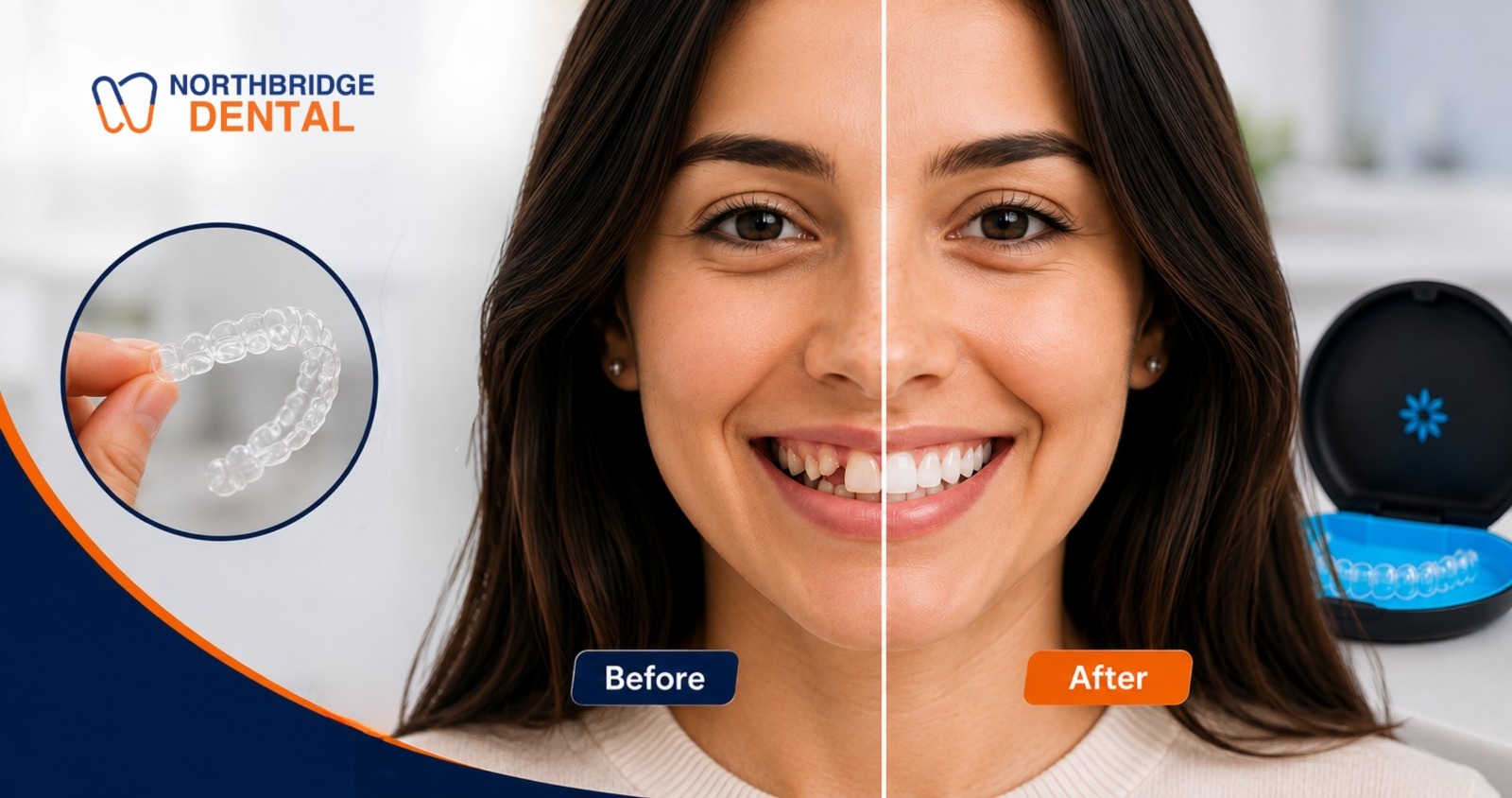
 If you’ve been putting off straightening your teeth because you’re picturing metal brackets and years of wires, Invisalign has likely changed what’s possible. Here’s what it actually treats, who it tends to work best for, and what to expect if you’re considering it at Northbridge Dental.
What Invisalign Can Actually Fix
Invisalign isn’t just for minor gaps. At our clinic, we regularly treat crowding, noticeable spacing between teeth, overbites, underbites, crossbites, open bites, rotated teeth, midline shifts, and even relapse after old braces. If you were told years ago that your case was “too complex” for clear aligners, it’s worth a second look—the technology has advanced considerably, and a free video consultation can give you a definitive answer at no cost.
Who Tends to Choose Invisalign
A few groups we see often:
- Brides and grooms wanting a camera-ready smile before their wedding day
- University students at UW, Laurier, and Conestoga—we’re a Studentcare network provider with evening and Saturday appointments
- Frequent travellers, since aligners are discreet and check-ins can be planned around trips
- Teens who want a nearly invisible alternative to metal braces
A Note on Starting Treatment Elsewhere
We occasionally see patients who started clear aligners or braces while visiting family overseas because the upfront price looked lower. In several of these cases, there was no proper consultation and no scheduled follow-up with the treating dentist. Aligner treatment only works when tooth movement is checked on a regular schedule—without that supervision, treatment can stall or drift, and correcting it afterward usually costs more than doing it right from the start.
What’s Actually Included at Northbridge Dental
Every treatment plan here is all-inclusive: your initial consultation, X-rays, photos, every progress visit, any necessary corrections along the way, and a free set of retainers at the end. There are no surprise add-on fees partway through treatment.
At Northbridge Dental, most cases are completed in 6 to 8 months. Aligners are worn 24/7, with the only exception being while you clean your teeth. Most patients feel mild pressure for a day or two after switching to each new tray—noticeably more comfortable than traditional braces.
Flexible Ways to Pay
We offer a few options depending on what works best for you—paying in full for the lowest total cost, a low-down-payment in-office plan, having your insurance billed directly on your behalf, or third-party financing through iFinance/Lendcare for the lowest monthly payments. Many insurance plans include orthodontic coverage, so it’s worth bringing your benefits details to your consultation.
Curious whether Invisalign could work for you? Book a free video consultation—no obligation, from wherever’s convenient for you.